
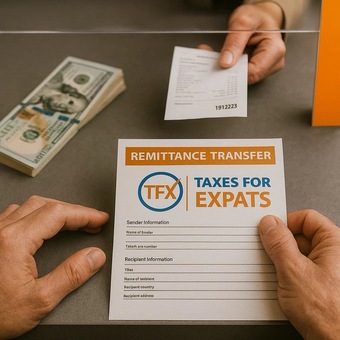




US remittance tax: Complete guide to the 1% rule (2026)

The US remittance tax is a 1% federal excise tax on certain money transfers sent from the United States to foreign countries, effective January 1, 2026. The tax applies only to cash-funded transfers, including cash, money orders, and cashier's checks. Bank account transfers and US debit/credit card payments are exempt under IRC Section 4475.
The tax was enacted as part of the One Big Beautiful Bill Act, signed into law on July 4, 2025. The rate evolved during Congressional debate – starting at a proposed 5%, and landing at the final 1% rate.
Collection falls to remittance transfer providers like Western Union and MoneyGram, who add it automatically at checkout. The Joint Committee on Taxation estimates the tax will raise approximately $10 billion in federal revenue over 10 years.
This guide covers who pays the tax, which transfers are taxed, exemptions, India transfer considerations (the second-largest US remittance destination), tax planning strategies, and compliance requirements.
What is the US remittance tax?
The US remittance tax (IRC Section 4475) is a 1% excise tax on money transfers from the US to foreign countries, effective for transfers made after December 31, 2025.
It applies to cash, money orders, and cashier's checks – but not to bank account transfers, US debit/credit cards, or cryptocurrency. The tax is paid by the sender and automatically collected by the transfer provider, such as Western Union, MoneyGram, or Wise.
The legislative basis is the One Big Beautiful Bill Act, enacted July 4, 2025. Remittance transfer providers must collect the tax and report quarterly to the IRS on Form 720. If a provider fails to collect, they are secondarily liable and must pay it themselves.
The tax applies to all senders regardless of citizenship, residency status, or income level. IRC 4475(f) also includes anti-conduit rules to prevent structured transactions designed to avoid the tax.
How did the tax rate change from 5% to 1%?
The remittance tax rate evolved through legislative negotiations: initially proposed at 5% in early 2025, reduced to 3.5% during Congressional debate, and finalized at 1% when the One Big Beautiful Bill Act was signed on July 4, 2025, effective January 1, 2026.
Early 2025: Original proposal (5%)
The remittance tax was first introduced through the REMIT Act proposal, positioned as both an immigration enforcement and revenue measure. The initial rate was set at 5% on all outbound remittances, with revenue projections reflecting the steeper rate.
Mid-2025: Revised proposal (3.5%)
The rate was reduced to 3.5% following pushback from advocacy groups raising concerns about the impact on working-class immigrant families. The banking industry also flagged compliance cost concerns, and economic impact studies were commissioned during this period.
July 4, 2025: Final law (1%)
The One Big Beautiful Bill Act was signed into law on July 4, 2025, with a final rate of 1%, effective for all transfers made after December 31, 2025.
The Joint Tax Committee estimates the tax will generate approximately $10 billion in federal revenue over 10 years – representing a small fraction of total U.S. outbound remittance flows, which exceed $100 billion annually. IRS Notice 2025-55 provided preliminary guidance shortly after signing, with full regulations expected in Q1–Q2 2026.
IRS Notice 2025-55 (issued October 7, 2025) provided limited administrative guidance, including deposit timing and transitional penalty relief. As of February 2026, comprehensive Treasury regulations had not yet been finalized, so providers and taxpayers should rely on the statute and existing IRS notices until further guidance is issued.
Which transfers are taxed?
The 1% remittance tax applies only to transfers funded with physical instruments – cash, money orders, cashier’s checks, or similar payment methods. Transfers from bank accounts at BSA-regulated institutions, US debit cards, and US credit cards are explicitly exempt under IRC 4475(d)(1).
Cash-funded transfers – subject to 1% tax
The following payment methods trigger the tax:
- Cash paid at a transfer agent location (Western Union, MoneyGram retail stores)
- Money orders used to fund an international transfer
- Cashier’s checks used for remittance purposes
- Other physical payment instruments as defined by Treasury regulations
Example: You bring $1,000 cash to Western Union to send to family in Mexico. Tax = $10 (1% of $1,000). Total cost = $1,000 principal + $10 tax + Western Union transfer fee (~$15) = $1,025 total.
Bank and card-funded transfers – no tax applies
The 1% tax does not apply to:
- Bank-to-bank wire transfers (ACH, SWIFT, SEPA)
- Transfers funded directly from checking or savings accounts at Bank Secrecy Act-regulated financial institutions
- US-issued debit card payments (Visa, Mastercard, Discover debit)
- US-issued credit card payments
- Cryptocurrency transfers (not classified as "physical instruments")
- Business wire transfers (generally outside the consumer remittance definition)
Why these are exempt: IRC 4475(d)(1) specifically excludes any transfer funded through an account maintained by the sender at a financial institution subject to the Bank Secrecy Act.
Provider comparison
Fees shown below are illustrative estimates. Actual fees and FX margins vary by destination, funding method, transfer speed, and date. Always verify current pricing directly with the provider before publishing fixed numbers.
| Provider | Cash transfer | Bank account transfer | US debit card | Typical fee |
|---|---|---|---|---|
| Western Union | Taxed (1%) | Exempt | Exempt | $10–25 |
| MoneyGram | Taxed (1%) | Exempt | Exempt | $8–20 |
| Wise | Rare (taxed if cash) | Exempt | Exempt | $3–15 |
| Remitly | Taxed (1%) | Exempt | Exempt | $4–20 |
| Bank wire | N/A | Exempt | N/A | $25–50 |
NOTE! Wise primarily accepts bank account funding, so most Wise transfers are tax-exempt. Western Union and MoneyGram offer both cash transfer and account options.

Sending money to India: what you need to know
Sending money from the US to India is subject to the 1% remittance tax only if you use cash, money orders, or cashier's checks at transfer locations. Bank transfers, ACH payments, and US debit/credit card-funded transfers to India are completely exempt from the tax. India is the world's largest recipient of remittances, with the United States as its single largest source country.
Tax-free transfer methods
Best options to avoid the 1% remittance tax when sending to India:
Bank account transfers (ACH/wire)
The most cost-effective option for sending money to India. By linking your bank account through Wise, Remitly, or Xoom, you avoid the remittance tax entirely – saving $10 on every $1,000 sent. Transfer fees range from $5–25, with funds arriving in India within 1–3 business days.
US debit card funding
A convenient option if you prefer using a mobile app. Wise, Remitly, and Western Union all accept US debit cards online, and debit-funded transfers are exempt from the 1% tax under IRC 4475(d). Processing fees run around 1–2%, and most transfers go through the same day.
US credit card funding
Tax-exempt, like the other methods, but comes with the highest fees – credit card processing typically adds 2–3% on top of the transfer fee. It's worth using only when you need to send money urgently.
Cost comparison for India transfers
If you must use cash (subject to 1% tax), here's the total cost breakdown:
| Amount sent | 1% remittance tax | Western Union fee | Total cost | Annual cost (monthly) |
|---|---|---|---|---|
| $500 | $5 | $12 | $17 | $204/year |
| $1,000 | $10 | $18 | $28 | $336/year |
| $2,500 | $25 | $30 | $55 | $660/year |
| $5,000 | $50 | $45 | $95 | $1,140/year |
Alternative with bank account: Same $500 transfer via Wise from bank account = $0 tax + $4 fee = $4 total. Savings: $13 per transfer or $156/year for monthly $500 transfers.
What to report as a US sender
Recipients in India pay no tax on family support remittances. Keep your remittance receipts as proof of tax paid, and note that a US FBAR filing is required separately if your Indian bank accounts exceed $10,000 in aggregate balance.
Remittance tax for Mexico and other countries
Mexico is the largest recipient of US remittances, receiving over $60 billion annually. The same 1% remittance tax rules apply: cash and money order transfers are taxed, while bank account transfers and US debit/credit card payments are exempt, regardless of destination country.
China, the Philippines, Vietnam, and Central American countries are among the other major destinations, and the same exemptions apply across all destinations worldwide.
Money-saving tip: No matter where you're sending money abroad, using a bank account or a US debit card instead of a cash transfer means you skip the 1% remittance tax entirely.
What are the exemptions?
The remittance tax has broad exemptions: all transfers funded from bank accounts at BSA-regulated financial institutions, transfers funded with US debit/credit cards, cryptocurrency transfers, and business wire transfers are exempt from the 1% tax under IRC 4475(d).
Complete exemptions under IRC Section 4475(d):
- Bank account-funded transfers: The most widely used exemption. Covers checking, savings, and money market accounts held at any bank, credit union, or other BSA-regulated institution.
- US-issued debit cards: Any Visa, Mastercard, Discover, or American Express debit card issued by a US financial institution qualifies.
- US-issued credit cards: All major US-issued credit cards are exempt, though some providers may apply cash advance fees depending on how the transaction is processed.
- Cryptocurrency and stablecoins: Since crypto is not classified as a physical instrument under IRC 4475(c), these transfers fall outside the tax entirely.
- Transfers initiated outside the US: The tax only kicks in if the sender is physically located in a US state at the time of transfer.
- Business wire transfers: Generally exempt, as they fall outside the consumer remittance definition.
The 1% tax applies equally to all senders regardless of citizenship, immigration status, or income level – there is no limit on transfer amount. Note that the remittance tax is a separate obligation from FBAR and FATCA reporting requirements.
How to avoid the remittance tax
Avoid the 1% remittance tax entirely by switching from cash funding to bank account transfers or US debit/credit card payments. For regular remittances, open a US bank account if you don't have one, and use ACH transfers or money transfer apps that accept account funding like Wise, Remitly, or Xoom.
Strategy 1: Switch to Account-Funded Transfers
The easiest and most effective way to eliminate the tax. Here are the best providers:
- Wise – Accepts bank account and debit card funding, offers competitive FX rates, and includes a multi-currency account option. Completely exempt from the 1% tax, with fees typically running 0.4–1% of the transfer amount.
- Remitly – Accepts bank account and debit card funding with fast delivery options. Fully exempt from the remittance tax.
- Xoom (PayPal) – Links directly to your PayPal account or bank account. Tax-exempt and easy to set up if you already use PayPal.
- Traditional bank wire – Fees are higher at $25–50, but it's fully tax-exempt and a reliable option for larger transfers.
To put the savings in perspective, if you send $1,000 every month, paying cash costs you $336 a year in taxes and fees. The same transfer via Wise from a bank account costs just $84. That's $252 back in your pocket every year.
Strategy 2: Use US debit or credit cards
Funding a transfer with a US-issued Visa, Mastercard, or Discover debit card is completely exempt from the remittance tax under IRC 4475(d). Wise, Remitly, and Western Union all accept card payments directly through their apps.
Credit cards are exempt too, but carry higher processing fees of 2–3%, so they're best kept as a backup for urgent transfers.
Strategy 3: Timing and consolidation
For those who occasionally use cash, consolidating multiple small transfers into fewer larger ones reduces total provider fees. If you send money on a regular basis, the best move is to open a US bank account – it gives you access to all the tax-exempt transfer methods covered above.
Reporting and compliance: what senders need to know
Remittance transfer providers automatically handle collection and reporting to the IRS quarterly using Form 720 (Federal Excise Tax Return). Individual senders receive transaction receipts showing the tax paid. No separate tax filing is required from senders on Form 1040.
For individual senders
Keep all remittance transaction receipts showing the 1% tax paid – the recommended retention period is three years minimum, in line with the standard IRS audit period.
IRC Section 36C may allow a credit against income tax liability for remittance tax paid. As of February 2026, the IRS has not issued guidance on this credit – do not claim it on your return until official instructions are published.
The 1% tax is not reported on your annual Form 1040. It's an excise tax collected at the point of transfer, and your provider handles all reporting on their end.
For transfer providers
Provider requirements and compliance obligations:
- Withhold 1% tax: Must collect tax at the time of transfer from the sender. Cannot be waived or absorbed by the provider.
- Quarterly reporting: File Form 720 by the last day of the month following each calendar quarter.
- Remit to Treasury: Pay collected taxes to IRS with Form 720 filing.
- Secondary liability: Provider is liable for uncollected tax under IRC 4475(b). If the provider fails to collect from the sender, the provider must pay the IRS.
- Record keeping: Maintain transaction records for four years.
Cost comparison: cash vs bank account
| Transfer method | $500 transfer | $1,000 transfer | $2,500 transfer | $5,000 transfer | Remittance tax? |
|---|---|---|---|---|---|
| Cash at Western Union | $5 tax + $12 fee = $17 | $10 tax + $18 fee = $28 | $25 tax + $30 fee = $55 | $50 tax + $45 fee = $95 | YES (1%) |
| Money order | $5 tax + $15 fee = $20 | $10 tax + $20 fee = $30 | $25 tax + $35 fee = $60 | $50 tax + $50 fee = $100 | YES (1%) |
| Bank account (Wise) | $0 tax + $4 fee = $4 | $0 tax + $7 fee = $7 | $0 tax + $15 fee = $15 | $0 tax + $28 fee = $28 | NO |
| US debit card (Remitly) | $0 tax + $5 fee = $5 | $0 tax + $8 fee = $8 | $0 tax + $18 fee = $18 | $0 tax + $35 fee = $35 | NO |
| Bank wire transfer | $0 tax + $25 fee = $25 | $0 tax + $35 fee = $35 | $0 tax + $45 fee = $45 | $0 tax + $50 fee = $50 | NO |
The numbers tell the story: switch from cash to a bank account, and the 1% remittance tax disappears entirely.
Example: A family sending $1,000/month pays $336/year via cash. The same transfers via bank account cost just $84/year – that's $252 in annual savings simply by changing the funding method.
Conclusion
The remittance tax is easy to avoid – transfers funded through a bank account or card are exempt, no tax applies, and no separate filing is required on your Form 1040. Retaining receipts for all transactions is nonetheless recommended.
For Americans abroad, however, this is only one element of a broader US expat tax framework. FBAR filing, foreign income reporting, and international tax planning each carry their own compliance requirements.
Taxes For Expats specializes in US expat tax preparation and international tax planning. Our CPAs have prepared over 12,000 expat returns and are well-positioned to help you stay compliant.
FAQ
No. The tax applies only to transfers funded with cash, money orders, or cashier's checks. Bank account transfers, US debit card payments, and US credit card payments are completely exempt under IRC 4475(d).
The tax became effective January 1, 2026, enacted as part of the One Big Beautiful Bill Act signed on July 4, 2025. Transfers made before that date are not subject to the tax.
The transfer provider (Western Union, MoneyGram, Wise, etc.) automatically collects the 1% tax at the time of transfer. Providers report and remit collected taxes to the IRS quarterly on Form 720.
Not yet. IRC Section 36C mentions a potential credit, but as of February 2026, the IRS has not issued guidance. Do not claim this credit on your return – keep receipts in case guidance is issued later.
No. The tax applies to transfers of any size with no caps or thresholds.
No. The tax is collected automatically and does not need to be reported on Form 1040. Keep receipts for your records.
It depends on the funding method. Cash or money order – yes. Direct bank-to-bank transfer – no.
No. Cryptocurrency, Bitcoin, Ethereum, and stablecoins are not classified as "physical instruments" under IRC 4475(c) and are therefore exempt.
The tax applies equally regardless of citizenship or immigration status. Anyone can avoid it by using bank account funding or US debit/credit cards instead of cash.
The provider becomes liable under IRC 4475(b) and must pay the IRS directly. Senders are not pursued for uncollected tax.
Generally no. Business-to-business wire transfers typically fall outside the consumer remittance definition.
Wise, Remitly, and Xoom transfers funded from bank accounts or debit cards are exempt. Most users of these platforms are unaffected.